
From Good Intentions to Linguistic Justice
Discover how everyday classroom decisions shape linguistic justice. Learn three coaching questions that help educators support multilingual learners.
Just what is linguistic justice?
I’ve written several posts about resisting the impulse to translate for an ML (here’s one, and another). The TLDR of these posts is that daily assumptions about an ML’s struggles to find the words for a response build up over time, deflating the confidence and innate curiosity a kiddo brings to their learning. Unintentional disempowerment… ick.
My solution, and the purpose for this essay is to move away from default translations towards linguistic justice.
But what exactly does that mean?
When people hear “linguistic justice,” they often think about monolingual legislation, programming, or district policy. And wouldtcha know- just last month the US government proposed a harrowing policy that seeks to eradicate heritage language support across all Head Start classrooms.

The thing is, monolingual pressures exist both in the macro right down to the micro, in much quieter places. The bias lives on with who gets called on. It lives in who gets to wait time. It lives in whether multilingual learners get to decide how they’ll use their languages… or whether adults decide for them.
When we consistently step in to "help" by making these language choices for students, we aren't just controlling the flow of conversation; we are inadvertently signaling that their own voices are insufficient. It is in these quiet, daily moments that we cultivate a deep-seated, often invisible, sense of linguistic shame.
Linguistic Shame Doesn’t announce itself
When we talk about linguistic justice, we often imagine promoting policy changes, student advocacy, more bilingual programming, and promoting language rights. And it’s true that this is part of it. But often, these are decisions made at higher levels or require a large effort to promote change.
Truth is, every educator has the ability to apply linguistic justice in their context of teaching. Consider the common decisions you make as an educator such as:
Who gets to answer a question first?
Who decides when translation happens?
Who gets to use their full linguistic repertoire?
Who defines what "participation" looks like?
All of my writing and keynotes promote the idea that teachers are more equipped than they realize to engage in everyday advocacy for their students. In short, you dear reader, who visits my blog in the hopes of finding instructional ideas or soundbites to inspire your ally group chat…. YOU possess the power to model linguistic justice in ways big and small.
And you can do this by engaging in some peer coaching as outlined below.
3 Coaching Questions that Accelerate Linguistic Justice
In our efforts to practice linguistic justice over shame, we can ask ourselves questions that guide us to be reflective educators. Let’s look at a few of the questions we can ask to help reveal (and dismantle) the Monolingual Bias our MLs often face in the classroom.
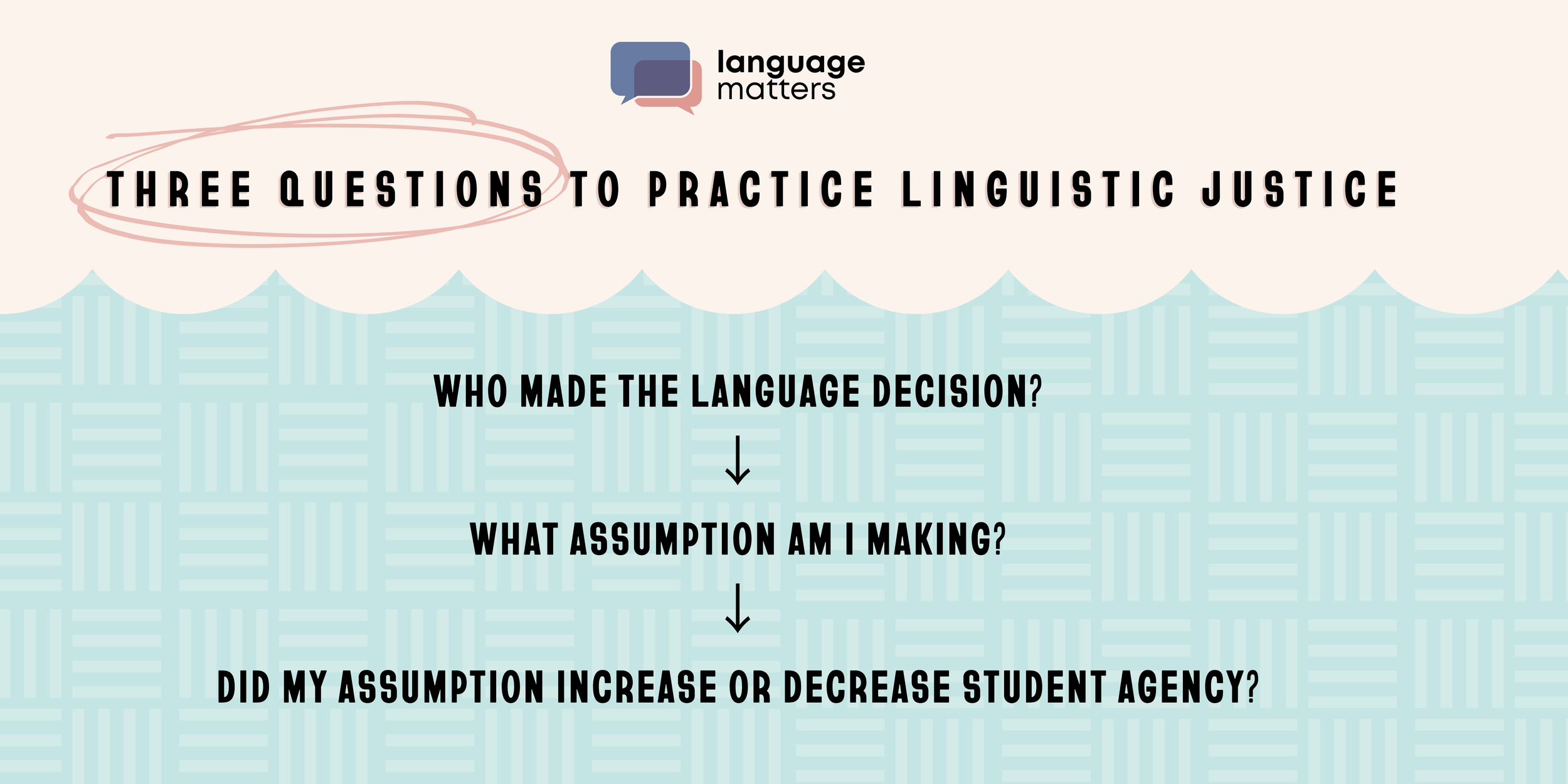
Question 1: Who Made the Language Decision?
Was it the teacher? The curriculum? The pacing guide? Or was it the student?
It’s a deceptively simple question that can reveal a powerful motive behind your choices. Thing is, you’re moving about your class instruction, often at lightning speed, and rarely pause to consider if your jump to translate gave your MLs the space for some much needed processing time. Are you up against a pacing guide that requires you to keep up with the monolingual classrooms? (news flash: that’s impossible)
You see, working in the service of linguistic justice asks us to shift from making language decisions for MLs to making them with MLs. When students have opportunities to choose how they'll access information, process ideas, or demonstrate understanding, we're doing more than supporting language development… we're communicating a level of confidence in their learning trajectories.
Question 2: What assumptions am I making?
Am I assuming this student is confused? That they're struggling with English? That a pause means they don't know the answer?
This one is tricky because assumptions are shadow parts of our belief system, tucked quietly away beneath the surface. We often don't have the capacity, support or awareness to see that we hold ideas about a learner until we’re prompted to unpack them (ideally with a close friend or mentor) without the watchful gaze of a teacher assessment tool.
Maybe your student is translating ideas internally. Maybe they're organizing their thoughts. Maybe they're doing exactly the kind of cognitive work we hope all students will do before responding. In fact, the messy inchoate output of a learner is something you SHOULD celebrate- this means a kiddo is pushing up against their zone of proximal development. Real language growth captured in real time!
Curiosity is one of the most powerful instructional strategies we have. When we replace assumptions with questions, we create space to discover students' strengths instead of unintentionally reinforcing their perceived limitations.
Question 3: Did This Interaction Increase or Decrease Student Agency?
Are they speaking more, showing engagement and enthusiasum for their learning…. or not?
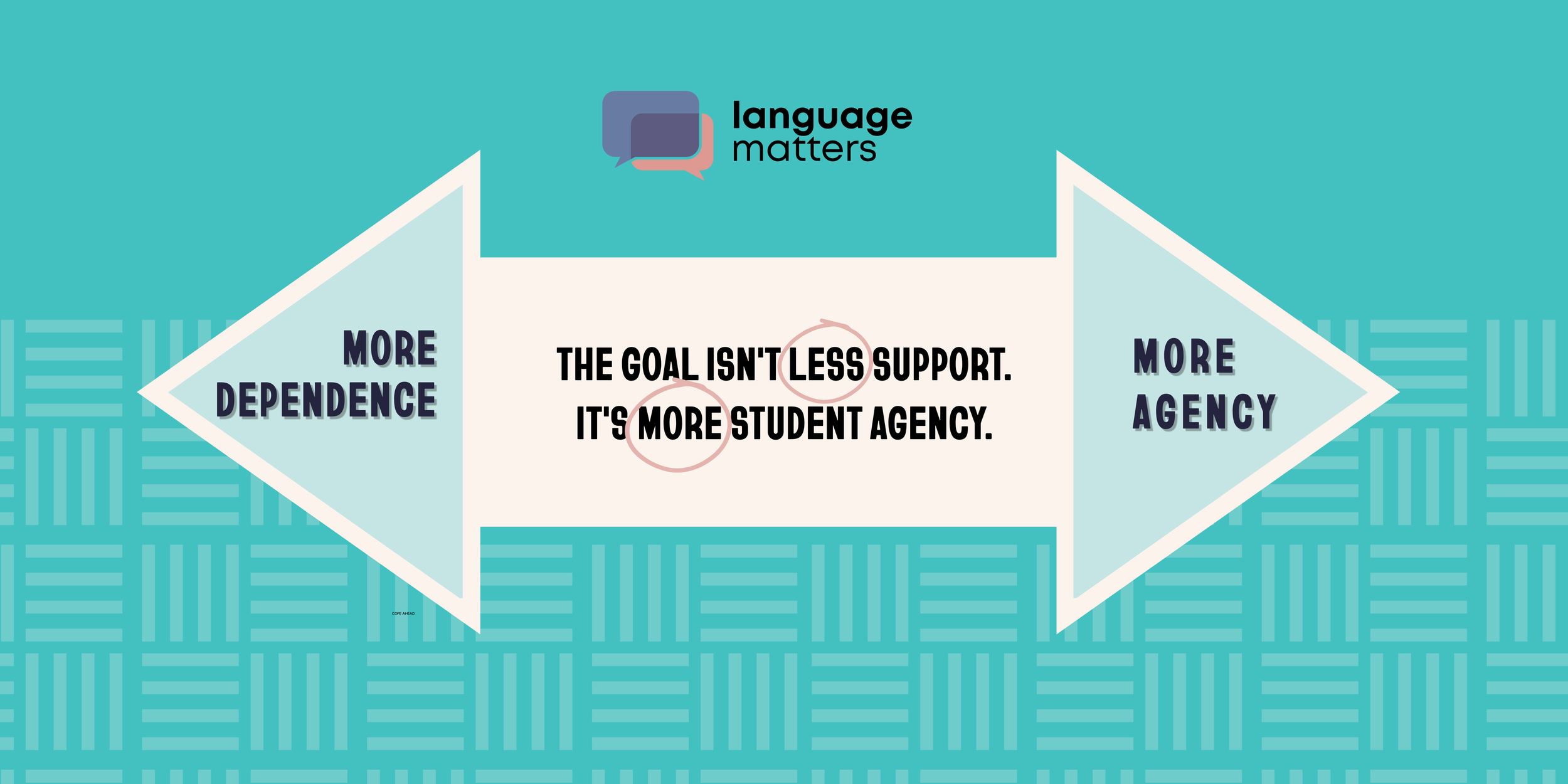
Consider whether your student is more confident navigating their own learning due to the support offered… Or have they become more dependent on me to bridge every language challenge?
That's the difference between helping and empowering.
Linguistic justice isn't about providing more support. It's about providing the right support at the right moment so that, over time, multilingual learners become increasingly confident in using their full linguistic repertoire to think, communicate, and lead.
From Awareness to Practice
The good news is that linguistic justice doesn't require us to become perfect educators. It asks us to become more reflective ones.
It begins with noticing the small moments that often pass by unquestioned: the automatic translation, the shortened wait time, the assumption that a student needs help before we've invited them into the conversation.
These moments may seem ordinary. But over time, they shape the messages students receive about their languages, their identities, and their capabilities. That's why this work can't be accomplished through a single strategy or a one-day workshop. It grows through reflection, conversation, practice, and the willingness to examine the habits we've inherited from systems built around the Monolingual Bias.
If you're beginning to notice these patterns in your own classroom – or across your school community – you don't have to navigate them alone.
Coaching for Linguistic Justice creates space for educators and leadership teams to ask better questions, examine everyday instructional decisions, and develop practical ways to build classrooms where multilingual learners experience greater voice, agency, and belonging.
Because disrupting the Monolingual Bias rarely happens through one big initiative.
It happens through hundreds of small decisions.
And every one of those decisions is an opportunity to choose linguistic justice.
