
Translanguaging vs Translation: Are You Really Supporting Students?
Are you supporting students… or speaking for them?
As educators, we want to remove barriers for our students. So when we see a multilingual learner hesitate or struggle, our instinct is to jump in with the support we think they need. Yet that very impulse, despite its good intentions, can end up stripping students of the chance to grow their language skills through problem solving and critical thinking.
And we can’t have that.
During a recent coaching session, I sat in on Stacy’s 7th grade civics class discussion about democracy. She asked one of her MLs if she knew of any examples of democracy in their school context. The student paused, taking a moment to consider what was being asked before trying to respond. Without thinking, Stacy immediately translated the question into Arabic. The student finally answered the question in English and the discussion continued.
After the class, we unpacked her decision to translate for her ML. Her response: “I was just trying to help.” She saw her student struggling and provided a way for her student to answer. But by stepping in so quickly, Stacy never found out if the pause was caused by confusion or the student simply taking the time needed to think of how to respond.
We need to ask ourselves, “Did the student ask for a translation?” Or could they have arrived at an answer with another type of support. And while translation is an alluring hack to keep the class discussion moving ever forward, there is an inherent tension when assuming what an ML needs before they've had the opportunity to show us. When we replace curiosity with assumptions, even our best intentions can unintentionally take away a student’s voice.
If this story feels familiar, you'll find more everyday moments like this in my guide: Doable Disruptions for the Monolingual Bias… small, practical shifts that help us interrupt assumptions before they become barriers. Because disrupting the Monolingual Bias doesn't show up in grand gestures. It exists in the questions we consider before we choose how to respond.
Translation is a tool. Translanguaging is a framework.
When handled with care, translation can be used as a vital component of the multilingual classroom that serves to dismantle barriers and facilitate student engagement with complex academic information. By providing timely support, educators can alleviate student frustration and bolster confidence, ensuring that linguistic hurdles do not impede participation. This tool is particularly essential during critical junctures – such as conveying safety protocols, welcoming newcomers during orientation, or engaging in family outreach – where the primary objective is to guarantee immediate access.
But let me be absolutely clear: our goal in education is to expand a students’ languaging resources, and that will require some cognitive effort on the part of our MLs. For this kind of macro-linguistic goal, translanguaging functions as a broader framework that empowers students to draw upon their full linguistic repertoire to construct meaning, navigate problems, and articulate ideas. By inviting learners to leverage their diverse internal language resources, this approach moves students up the Bloom’s taxonomy (e.g. analysis, critical thinking, evidence-based learning) and enables them to forge significant connections across their various languages.
The difference between translation an translanguaging is subtle but important.
The difference between translation and translanguaging is subtle but important. Translation asks, “How can I get this information to the student.” But translanguaging asks, “How can the student use all of their language resources to do deeper thinking?" When we understand the difference, we stop viewing multilingualism as a problem to solve and begin seeing it as a resource to leverage. The goal isn't to translate every word a student might not understand. It’s to create opportunities for students to think, communicate, and learn with the full range of knowledge they possess.
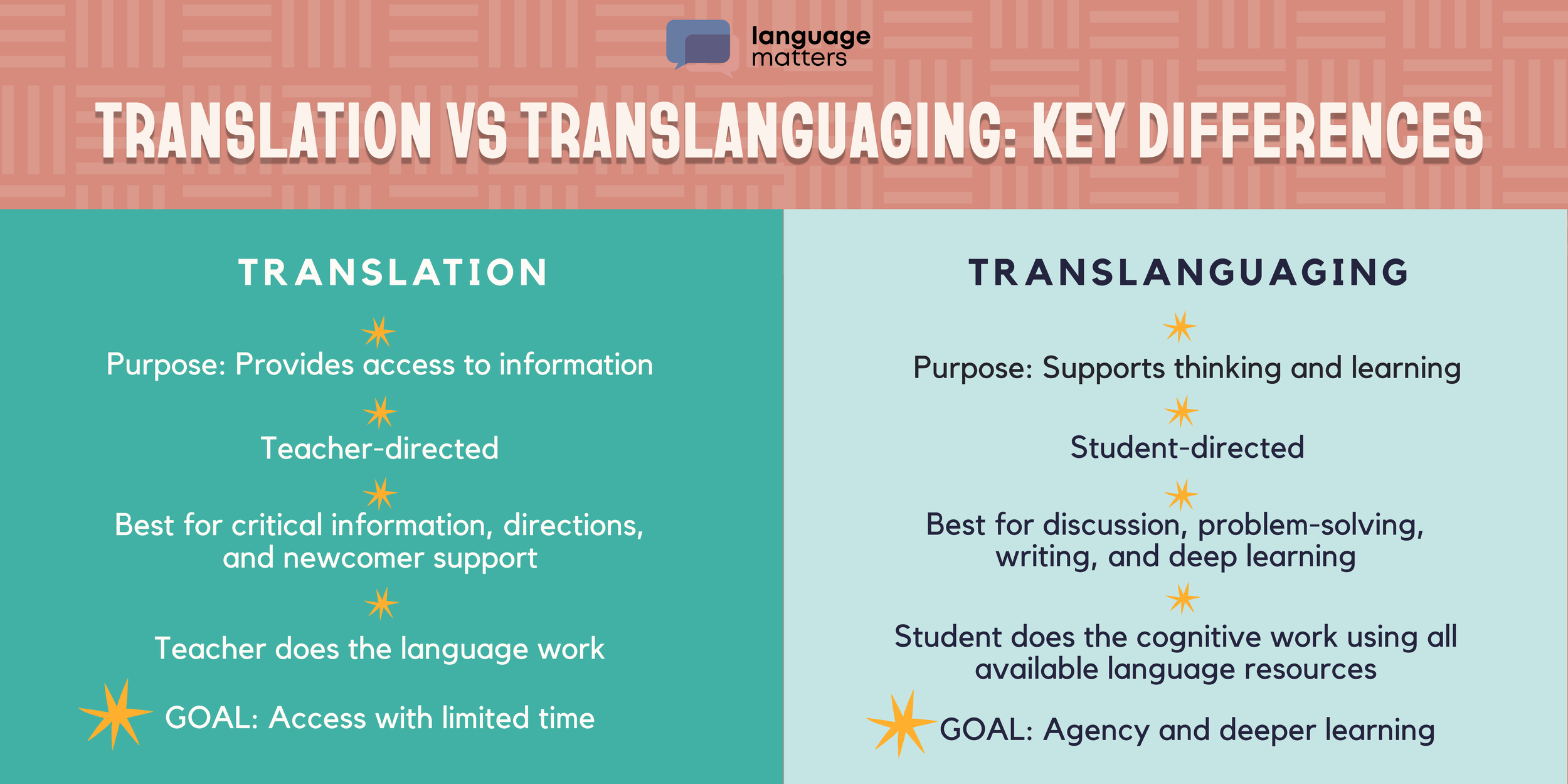
When Helping Starts Replacing Student Thinking
The Monolingual Bias often shows up quietly and slowly, not through harmful intentions but through automatic habits. When we immediately translate without first asking what a student needs, we may unintentionally communicate negative messages such as: I don't think you can figure this out on your own. Productive struggle isn't for you. Your home language is only valuable if it’s converted to English. Over time, these messages can shape how a multilingual learner views themselves and their ability to communicate.
Before you jump to translate the next time a multilingual learner appears to be struggling, pause and ask yourself, "What problem am I solving?" If the problem is access, for example, the student isn't understanding key information, or you need to communicate something essential such as a safety procedure or important directions, translation might be the right support.
But if the struggle is uncertainty, hesitation, or the natural challenge of processing ideas in another language, try to resist jumping to translation. Instead, ask the student what is getting in the way and consider whether another support, such as translanguaging, wait time, or a clarifying question, would better help them reach understanding. The goal isn't simply to help students complete the task or answer a question. We want them to become more independent and confident communicators. When we allow students opportunities to think and use all their linguistic tools, we shift from supporting multilingual learners to truly empowering them.
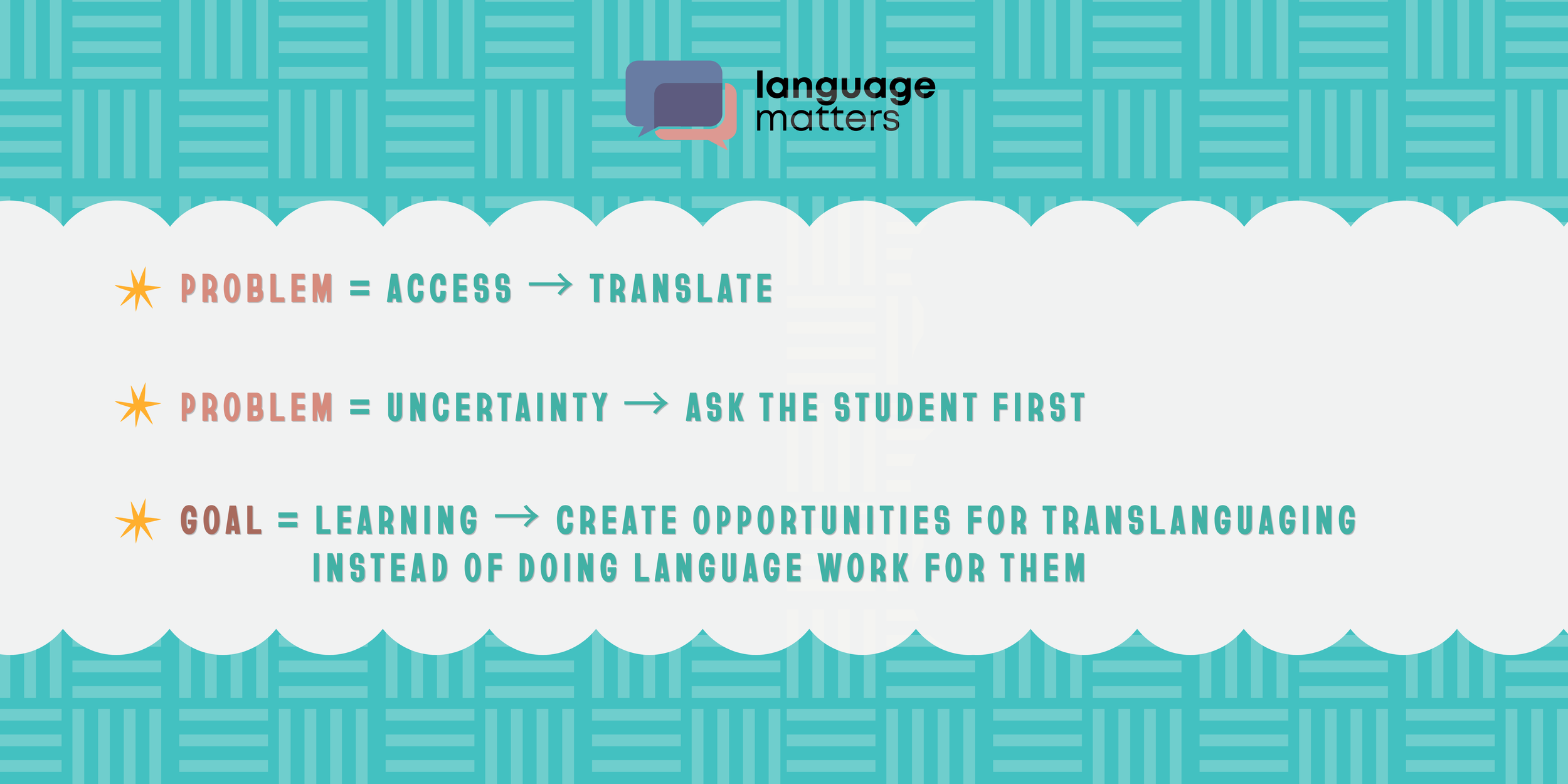
Let’s restore student agency.
The next time you notice an ML pause before responding, resist the urge to jump to translation. Instead, ask questions that let the student into the decision-making process:
How would you like to work through this?
Would it help to talk it through in another language first?
What language resources would help you here?
These questions do more than gather information; they restore agency. They communicate that students are active participants in their own learning, not passive recipients of teacher support.
If you're wondering whether your classroom is truly supporting translanguaging, or unintentionally falling into some common "misfires"... download my Translanguaging Misfires Checklist. It's a practical guide to the subtle ways well-intentioned educators sometimes confuse translation with translanguaging, along with simple shifts you can make to better honor multilingual learners' full linguistic repertoires.
