
Why SOR is bad for ELs: Part 1
Narrowing literacy curriculum does harm, not good, when it comes to English Learners.
This 2-part essay is my contribution to teasing apart Science of Reading policies’ impact on Multilingual Learners and the teachers who serve them. The intended audience is anyone who has linguistic justice beating in their hearts AND who knows that oracy and language play are cornerstones of a rich literacy block.
“I just feel like we’re choosing between two good things”
During an October PD day outside Madison, WI, Xiomara, a veteran 4th grade dual language teacher, found herself face to face with the new Science of Reading policy requiring her attendance at an English-curriculum training.
"I worry we're losing instructional time on Spanish literacy," Xiomara said, stacking decodable readers. Courtney, the SOR trainer, countered with urgency: "The data is clear—the fastest way to close the achievement gap for English Learners is to accelerate English literacy and prioritize English phonics. Don’t you want that for your ELs also?"
Xiomara thought of her bilingual students and the progress she had been making. She loved designing role plays and readers theater, these oracy based activities were the heartbeat of her bilingual classroom. Was Courtney really asking her to give all of this up?
Xiomara responded “It just feels like a choice between two good things, and I’m not sure we’re making the right one.” She wanted to mention research on biliteracy, but didn’t dare. Her principal’s mind was made up and she isn’t one to rock the boat.
Vocabulary you need to know:


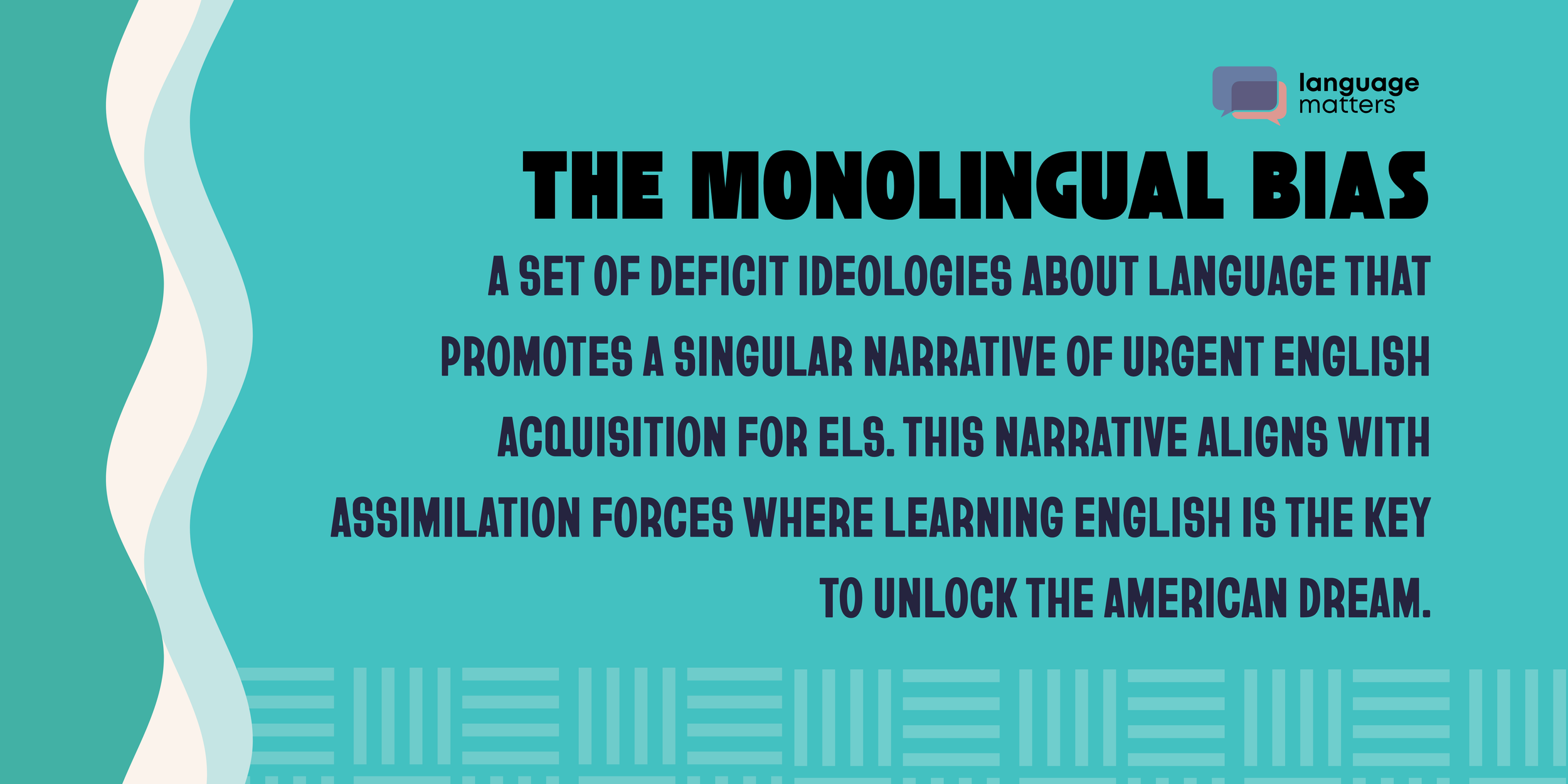
Go ahead and rock the boat.
If you, like Xiomara, feel like a casualty of the Reading Wars, welcome in. It is my professional observation that the Science of Reading's rigid, monolingual focus on phonics actively harms multilingual learners by reducing literacy to a linear decoding model. With this phonics first mentality, bilingual and EL students lose access to oral language development AND those rich, culturally sustaining pedagogies (e.g. translanguaging and biliteracy blocks). Moreover, the education system steeped in a Monolingual Bias actively discourages teachers like Xiomara to advocate for ELs, labeling such advocates as rabble rousers or misinformed about the research.

You are not wrong. You aren’t misinformed, and you are not stepping out of line. Disrupting these rigid SOR policies is the only way forward for linguistic justice—reclaiming space for authentic biliteracy, protecting rich oral language development, and restoring joy to bilingual classrooms.
Welcome to the Movement.
But I thought bilingual scholars endorse SOR?
Eh….. not really.
Since I am a rebel rouser at heart, and I give 0 farts about making my views on SOR known to my scholarly community, I find myself in private conversations with some of the biggest industry leaders. These are people who carry massive influence in education reform in so far as bilingual learners are concerned. I've seen these figures face intense pressure to speak at The Reading League's annual conference to offer their soft support of SOR for MLs.
Each time they author a “joint statement” or appear on a panel, they feel their skin crawl. When I ask them why they participate in this charade, their argument is utterly reasonable: “Lillian, if I don't advocate for MLs to an audience of SOR truthers, then who will they listen to? I use my platform to educate and hope that some people will learn who I am and read my scholarship on what's best for multilingual learners. While I don't expect truthers to abandon SOR, I hope they can widen their aperture to consider perspectives anchored in biliteracy research.”

Putting the pieces together on SOR for MLs
The power of SOR lies in its insistence on monolingualism. Its foundational assumption is that early readers must master the phonological system of a single language before they can begin to construct meaning (Hover & Tunmer, 2020; Moats, 2020). This creates a rigid, linear decoding model that reduces reading to sequential mechanics rather than an integrated, language-rich process. When this linear framework is coupled with intense policy pressure around "achievement gaps" and "struggling readers," the system overindexes on English Learners.
As scholars like Ofelia García and Kate Menken have documented, categorizing ELs as perpetual deficit subgroups creates a paradox: policies designed to bring them "up to speed" actually limit their access to complex text and meaningful oral language development (2020). Fueling this urgency is a revisionist narrative claiming that balanced literacy set reading scores back for two decades. The resulting mandate requires doubling down on early-grade phonics and pushing intensive tier 2 and 3 interventions onto older multilingual students who still struggle with decoding, ignoring the vital role of background knowledge and native language transfer (National Council on Effective Literacy, 2022).
In fact, the NCEL put together a comprehensive report on best practice for MLs which states: “Multilingual learners requiring additional literacy support receive linguistically and culturally sustaining instruction aligned to their language development across program languages, with ongoing progress monitoring,” (2026). In other words, any tier 2 or 3 isolated phonics instruction that does not account for linguistic or cultural context forsakes what bilingual literacy scholars endorse. Full stop.
Part 1- Concluding Thoughts
To summarize, I’ve made the following claims:
Science of Reading policies narrow literacy activities to a heavy focus on English phonics and phonemic awareness.
The US educational system is steeped in a Monolingual Bias. Accelerated English language acquisition for ELs is highly valued, and any policies that align with this goal are adopted without scrutiny.
Even bilingual ed scholars get pressure to publicly offer soft support for SOR, despite the fact their scholarship endorses linguistically sustaining pedagogies. This, in my mind, is a paradox.
If you are an ally to linguistic justice, then my hope is you will metabolize some of these ideas while collecting evidence from your experience on the front lines of public education. What about Xiomara’s story resonates with you? When you learn that bilingual ed scholars are someone coerced into support of SOR, does that shift your perspective?
I’ll pause for now, with the focus of my Part 2 to share scholarship on best literacy practices for ELs/MLs… and conclude with 3 ways you can disrupt SOR policies in your district. In the meantime, enjoy the last few weeks of Hispanic Heritage Month, stay grounded and continue to fill your resistance capital by booking a call with me to share your thoughts on SOR for ELs!
