
How an asset-based framework for bilingual learners transforms multi-tiered support
In my work with advocates across the globe, I help educators re-examine existing systems through a monolingual/English-first lens. This essay examines one educator's firsthand encounter with the damaging impact of the Monolingual Bias during an intervention meeting.
MTSS and the Monolingual BiaS
Last fall, Gulianna—an ESL teacher in a suburban upstate New York district—shared a story in one of my linguistic justice cohorts about a high-stakes MTSS meeting. It captured a deeply fraught exchange between herself and a fourth-grade teacher (Jenna) regarding how best to support an emergent bilingual student.
"Sima just sits there daydreaming and when she does speak, it’s in Arabic," Jenna complained, staring impatiently past Sima’s parents. "And you know I don’t speak Arabic—nor should I be expected to. What Sima really needs pull-out phonics instruction, not modifications from me."
Beside them, Sima’s father cleared his throat, holding up a translation app: "Sima... work hard at home." Guilianna could feel the desperation in his voice as Jenna shut him down mid-sentence: "Let’s keep focused on the school data Mr. Al-Mansoor." Watching him shrink back broke Gulianna’s heart, but Jenna’s dismissive glare forced Gulianna to advocate for Sima once more.
"If we push her into a self-contained SPED room, we're denying her access to core content," Gulianna asserted, refusing to let Sima become another casualty of the Monolingual Bias. But no matter Gulianna’s efforts, Jenna remained stubborn, her mind made up.
"I don't have time to be an ESL teacher AND the main fourth-grade teacher," Jenna fired back. "So what are you going to do about it?"
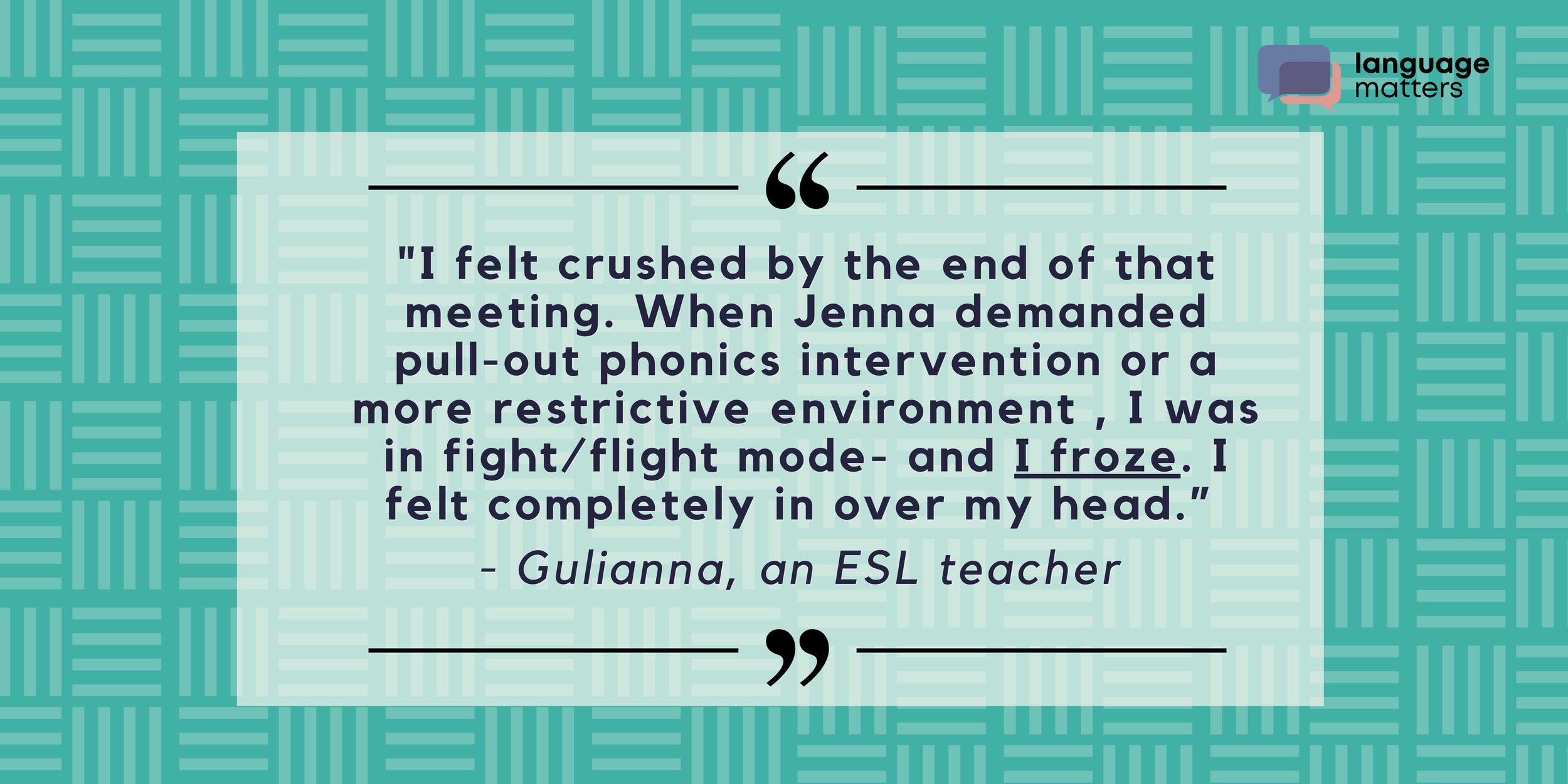
I’ll never forget Gulianna’s reflection on this moment:
Become an endurance advocate
Research consistently shows that emergent bilinguals are frequently over-identified for special education when language acquisition needs are mistaken for learning disabilities (Mendoza et. al, 2026, Ortiz & Chow, 2026). In the story above, Guilianna felt stuck, she lacked the tools, language or support to convince Jenna that special education is NOT the right place for language development.
Shifting from a deficit mindset to the creation of proactive instructional support can be the difference between Sima getting a referral for special education to find pathways for her continued academic growth and cultural accommodation. Which brings me to the main point of this post:
Dismantling the Monolingual Bias demands creativity, courage, and an open heart. You must work to reshape existing infrastructures like MTSS to ensure English acquisition doesn’t erase a student’s access to their culture, language, or humanity. When you utilize my framework for advocacy, you become an endurance advocate, poised to build liberating spaces where dually identified learners can shine.

Channel your inner Phoebe as you train for endurance advocacy.
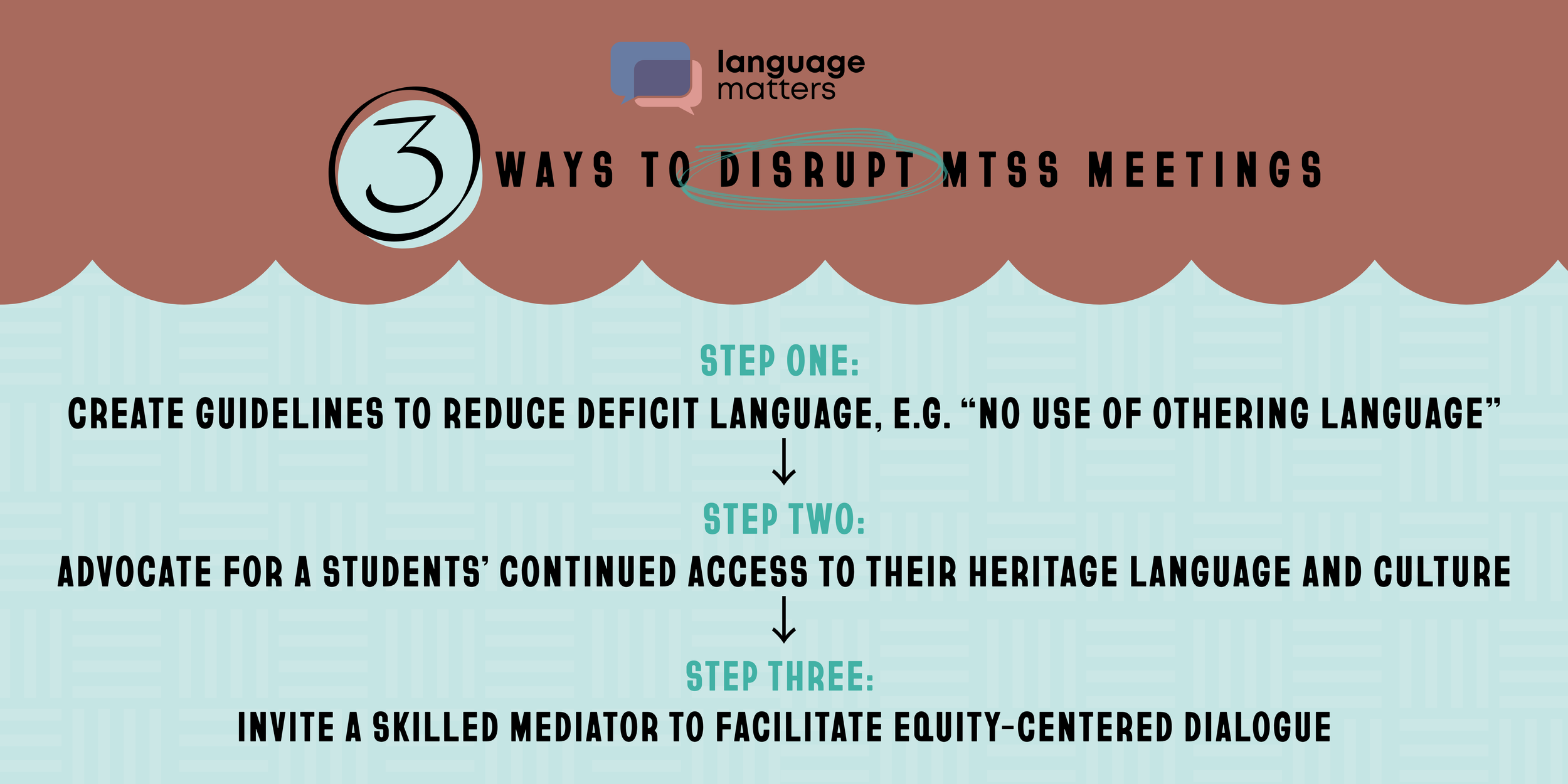
In my advocacy playbook, Disrupting the Monolingual Bias, I mention the utility of Doable Disruptions- these are everyday moments of advocacy that you can enact directly within fraught spaces like an MTSS meeting. Since the bias won’t disappear on its own, take the advice I offered to Gulianna and do these three things.
3 Steps to disrupting your MTSS meetings
Step 1: Create guidelines to reduce deficit language
One of the most direct and actionable steps you can take is to create guidelines around the kinds of language that are permissible in your MTSS discussions. Listen for when teachers use words like “your students” or “not my responsibility”. Reflect on whether the entire team shares the goal of prioritizing urgent English proficiency. Calling out these assumptions gives you back some instructional agency and pumps the breaks for special ed assessments and the accompanying remediation pipeline where your emergent bilinguals are concerned.
Step 2: Advocate for a students’ continued access to their heritage language and culture
Yes… you will sound like a broken record. Sometimes advocacy is the simple act of repetition of concepts that others believe have no place in discussions of multi-tiered support. But that is precisely why you must mention this is a value anchored in linguistic justice. If pulling a student into remedial activities comes at the cost of participation in richer, culturally aligned learning activities, then urge all support personnel in the room to reconsider the pathways to intervention. Which brings us to the third and final step of this framework.
Step 3: Invite a skilled mediator to facilitate equity-centered dialogue
Of all three steps, this is the most crucial one. And the one that will require some effort and collaboration.
In my framework for teacher advocacy, skilled mediators play a central role. They possess the unique ability to navigate tense dynamics, balance competing agendas, and guide every participant toward mutual goodwill and constructive engagement with the issue at hand. Typically, these facilitators are local translators or community organizers connected to your school. Their support is vital for effectively implementing the first two steps of this framework during MTSS meetings.
And if you need one more resource to help you move towards linguistic justice, check out my guide on Doable Disruptions to the Monolingual Bias:
Disrupting the MTSS Meeting with Jenna
The story does have a happy ending. Gulianna and I strategized about how best to move through her frustration and anger towards Jenna, toward a place of resolve and endurance advocacy. I nudged Gulianna to circle back with Jenna and lay out the above guidelines—doing so with compassion for Jenna’s feelings of overwhelm in supporting Sima.
This was Gulianna’s closing statement:
"It was tense, but I realized quickly that fighting Jenna head-on was just going to make her dig her heels in deeper. Right after Jenna silenced Sima’s dad—I knew I had to pivot the energy in the room. I decided to go full mediator with Jenna by honoring her frustrations while advancing the least restrictive environment for Sima.
I told her, 'Look, I hear how hard this is, but watering down content violates Sima’s rights to grade-level instruction.' I proposed a six-week MTSS trial where I provide graphic organizers, sentence frames, and key vocabulary cards for a few of her fourth-grade units. If we don't see progress with true language accommodations, then we discuss special education evaluation.’ It kept Sima in general education, gave Jenna a tangible lifeline, and brought the parents into a clear plan."
When I asked Gulianna how this alternative approach resonated with her values as an ESL teacher she smiled, with tears welling up in her eyes. “Lillian, when I get the small victories…. It all feels worth it.”
