
Are You Translanguaging...or Just Translating? Avoid These 4 Misfires!
It’s 2026 and AI generated tools are ubiquitous in the modern classroom. How simple it is to click a button and translate an entire lesson for your newcomer or intermediate language learners. And if you’ve been lucky enough to attend any trainings on translanguaging—the natural and flexible way bilinguals use all of their language resources to make meaning (García & Wei, 2014), then you have likely began infusing these translation tools with the intention of doing translanguaging pedagogy for your students.
But unlike many letters and their corresponding sounds, these two concepts do not share one-to-one correspondence. Simply put, an over reliance on translating can lead to instructional misfires that undermine deeper content area learning. AND they can delay the English acquisition journey for your students.
No one wants that.
An over reliance on translating can lead to instructional misfires that undermine deeper content area learning for our MLs.
Many teachers, despite the best of intentions, fall into the trap of using a student's home language merely as a tool for decoding or rote conversion—a quick "translate this word" moment. As if language is a mere interactional dictionary, and that’s all it takes to acquire new academic concepts. (It’s not). True translanguaging is not about moving between two named languages; it’s about mobilizing a single, integrated linguistic repertoire. It focuses on the cognitive process, the complexity of an idea, or the co-construction of knowledge, not just vocabulary transfer.
This pervasive error stems from what I refer to as the "one-language-solution mindset"—the belief that academic content can (and should) only be acquired and demonstrated through a single, often dominant, named language (English, in this country that’s English).
Click over to read more about this false dichotomy in an earlier blog post about translating as a predictable outcome of the Monolingual Bias.
The cringe is real, mi gente
So, how can you tell the difference? One common misfire is using the home language only for low-level tasks, such as finding dictionary definitions, while reserving complex tasks solely for the target language. Another is the expectation of perfect, word-for-word translation, which ignores the nuance and context- and culture-specific use of language. These "translating traps" limit bilingual students’ intellectual capacity and reinforce the idea that their languages exist in separate, unequal boxes.
To move beyond these pitfalls, you need a clear understanding of the key differences. Download my free guide, "4 Translanguaging Misfires," to learn the common mistakes and get practical strategies for fostering authentic translanguaging in your classroom.
Authentic translanguaging is about giving students permission and purpose to use all their linguistic funds of knowledge to reason, problem-solve, and create. And if you’ve been reading my latest book on Disrupting the Monolingual Bias, then you know we need all hands on deck to dismantle the deficit thinking about Multilingual Learners and their families! Because as the legendary Kathy Escamilla puts it: “Translating is the easy thing, not the equitable thing to do.”
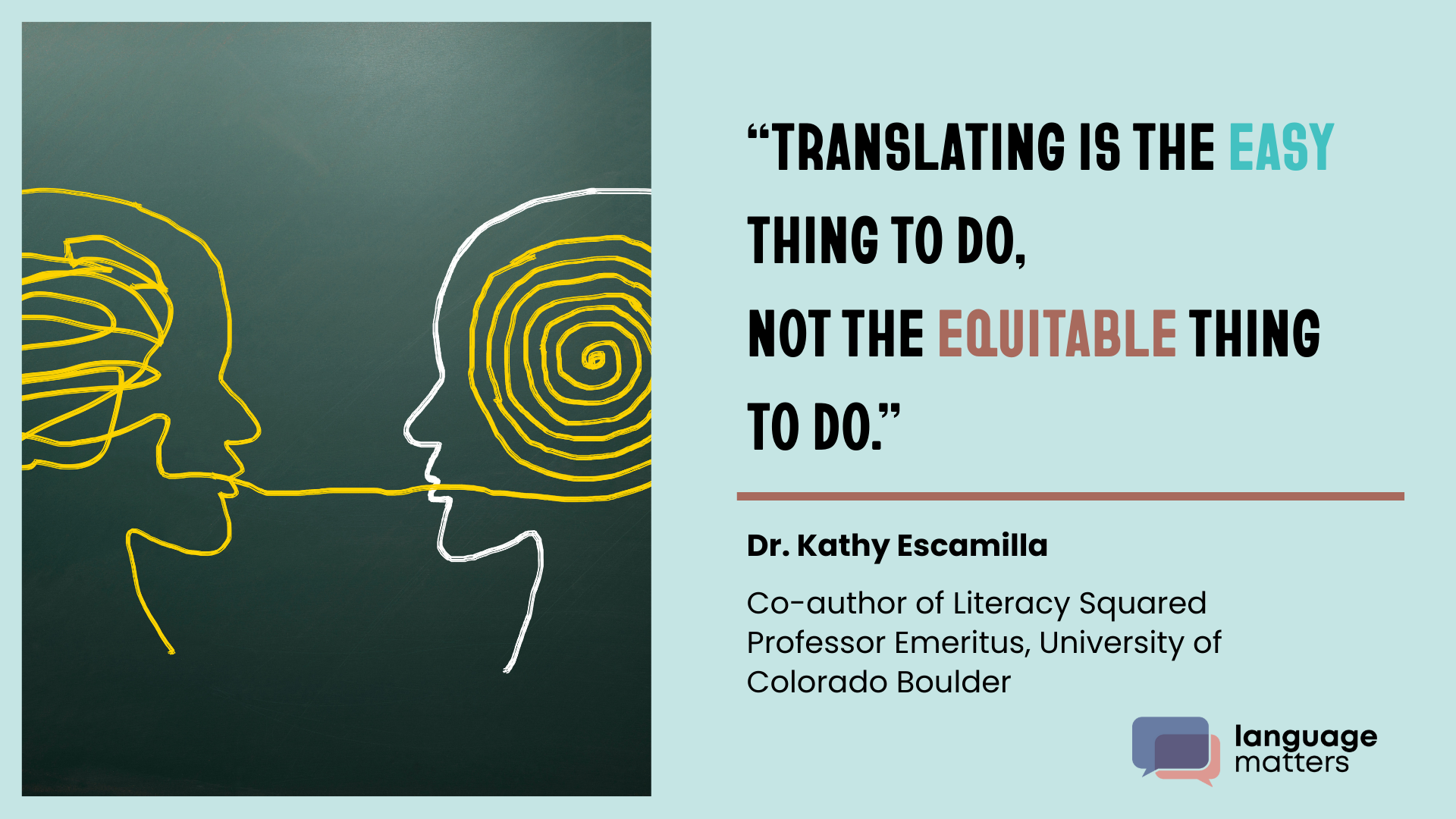
Translating is the easy thing to do, not the equitable thing to do for our newcomer English Language Learners.
